
Yesterday I inspected the house, and Kunihara-san explained to me the work he has done in the two weeks of my absence.
The main room looks essentially the same as before, however the wall in the middle is now filled with cellulose. And the flooring is covered with boards for protection.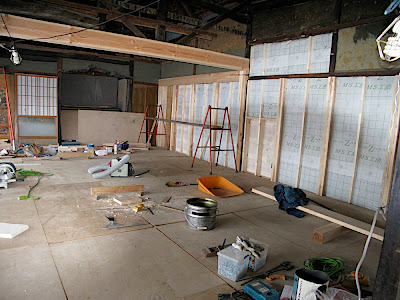
The kitchen is now complete, and we only need to finish the walls and add the centre kitchen, furniture and fridge.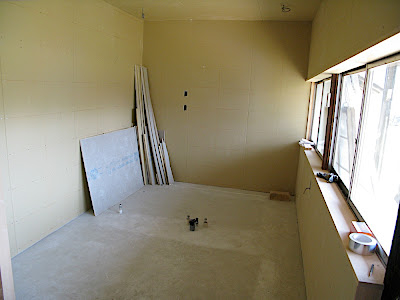
The bedrooms are also complete, with only the window frames waiting to be filled with double glazing. Please note that we only use 4 star boards, that are from sustainable forestry production. 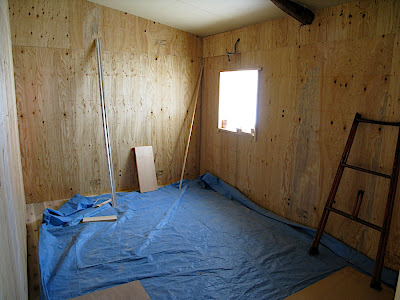
This shows the corridor behind the kitchen, were toilet and bathroom are located. Kunihara-san, closed off the end of the corridor, so that we can add a wash basin.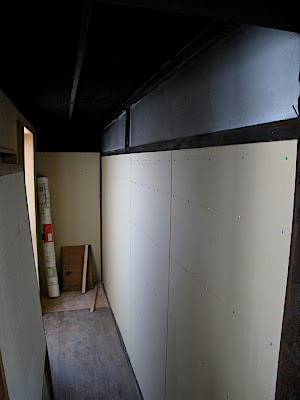
And finally the exit to the Kura (store-house) was permanently sealed, to comply with building regulations. From now on we must access it from outside.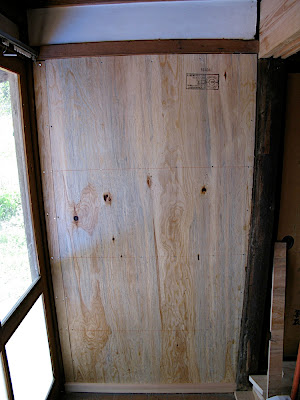
Wednesday, 30 April 2008
Carpentry nearly finished

Cellulose Blow-In Insulation
After some forward and backward, we decided to use environmental friendly cellulose for insulation. The stuff is basically made out of recycled newspapers, with the addition of fire retarding borates, a naturally occurring salt that is harmless to human health and the environment.
In this case we do not need to put insulation material before attaching the membrane, but the other way round: The membrane is added first and sealed, and then the blow-in machine's tube is inserted into a small hole cut for this purpose. The contractor then feeds the cellulose packs into a machine that shreds it and then blows the fibres into the cavity. After the cavity is filled up, the hole is sealed with a tape.
The advantage of this approach is that even the uneven walls, beams and posts can be packed in tightly with insulation material.
This shows one of the bedrooms being prepared for the blow-in contractor.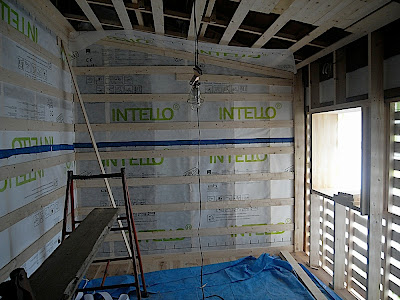
This is the outside of the house, now including the new window frames. and a new wall segment.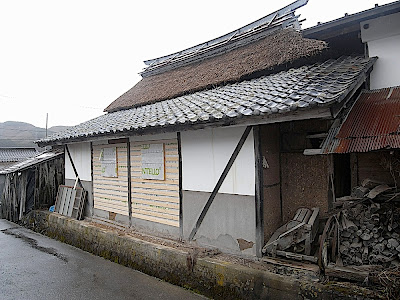
The living room is regarded as relatively "cold" because of the window-front, and the bed-rooms are therefore insulated from it.
Monday, 7 April 2008
Flooring preparation
After the weak beams and post have been replaced, Kunihara-san put up some speed and is now working towards the flooring preparation.
First let's look at the repair work of last time from a bit closer. The view is much better after the scaffolding is removed, and you can see the four beautiful wood pieces fitting together neatly.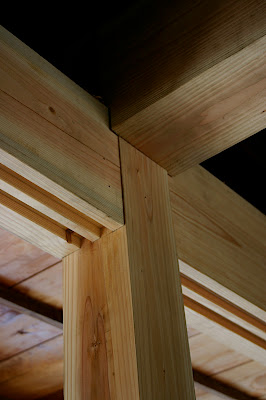
This photo shows an extension joint - two wood pieces have been put together without any kind of nail or other metal piece.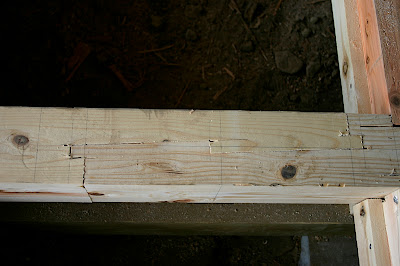
This shows how the concrete bases work: at the time they were poured, it was ensured that they are level, and now it is much easier to place the framework for the flooring on top. 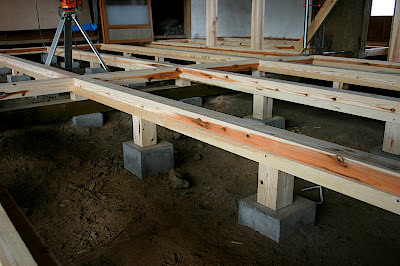
This shows again the main room with all bases, and framework complete.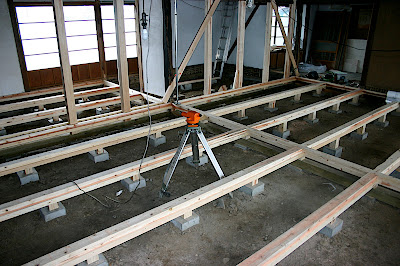
Here a floor insulation panel is cut to size and ready to be inserted into the framework.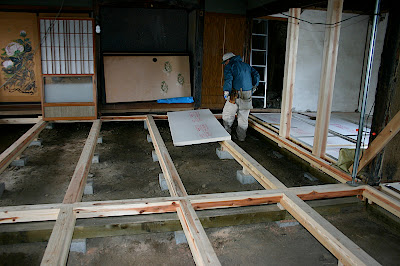
Kunihara Junior, follows up by taping the seams of the panels, so that the floor becomes airtight, a precondition for heating and cooling efficiency.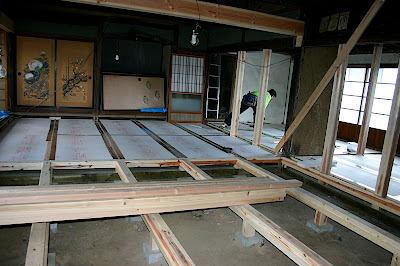
Sunday, 2 March 2008
Eco Membrane for the house
Inaka Home is to become a model house to demonstrate a new ecological high tech membrane, that is used to finish off building insulation on the inside. The name of the product is "intello" manufactured by a company called "proclima" in Germany (see pdf file at bottom of this page). It is a kind of membrane that regulates humidity exchange between the inside and the outside of the house, thereby not only preventing condensation and related mould issues, but also keeping warm in winter (no loss of heat) and cool in summer (reduced air conditioning cost). This product is new in Japan, and is now being actively promoted by Eco Transfer Japan to architects and other builders.
Our home, is of course not completely air tight due to its traditional Japanese construction method, but nevertheless it will help to conserve heating and cooling energy, and demonstrate how such a high tech component greatly enhances other natural building materials, like breathing insulation (wool/recycled cellulose/wood chips) and mud walls.
