
Previously we used a mud mix, consisting of the red earth, a bit of straw, and some coarse sand. The result was a sticky mixture, which however ended up having a few cracks. That is fine for the first layer, and actually helps the second layer to adhere better.
This time we were able to cover all last time's panels with the finishing layer. The ingredients were quite different:
1- Loads of fine Silica Sand
2- Half a load of red earth
3- finely chopped ("pulverised"=> thanks Mira!) straw in large quantities
4- A bit of four star wall paper glue
Before applying the mixture we sprayed a mist of water on the lower layer, to prevent to fast absorbtion of water, which could lead to cracking or incomplete binding.
The straw shines through the mud after application, which makes for a nice texture and pattern.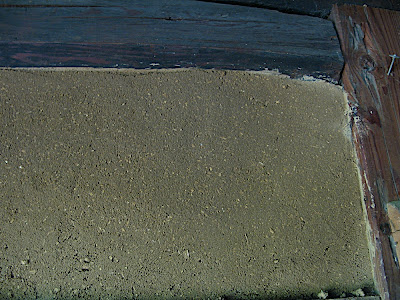
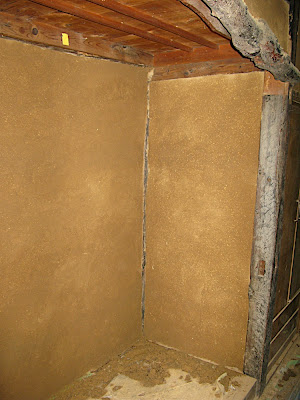
Once dry, this surface should lighten up markedly.
Respect to the manly crew of ISSHO mud mixers. It was a tough job in the heat, and this silica sand is much heavier and harder to work with. They kept the supply coming all day, enough to make us, the trowellers sweat in streams.
Wednesday, 23 July 2008
Mud finish layer

Monday, 12 May 2008
Soilogogy - finding the right mix
Having obtained the clay rich soil, it is now necessary to find the right mix to use it for our walls. We need it as both infill, but also consider it as a finish for some walls. A useful mix can be obtained by combining clay, sand, fibre and water, alas the optimum combination is difficult to find as the clay content and type varies. I therefore tried our different combinations on a spare wall.
This Video shows the mixing process:
The mixtures:
1. Sand 0 handfuls, red earth 10 handfuls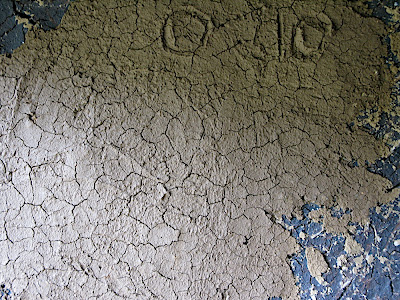
This mixture was nice and sticky but developed large cracks after drying.
2. Sand 5 handfuls, red earth 10 handfuls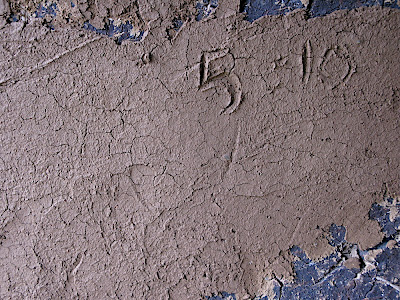
This mix was also nice sticky, but cracks still occurred even though less than the previous mix.
3. Sand 10 handfuls, red earth 5 handfuls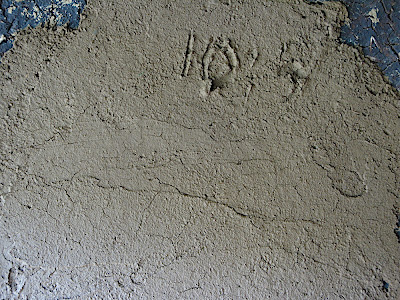
By having double the amount of sand compared to red earth, cracking could be removed strongly. However, they are still present.
4. Straw 4 hand bushels, Sand 5 handfuls, red earth 10 handfuls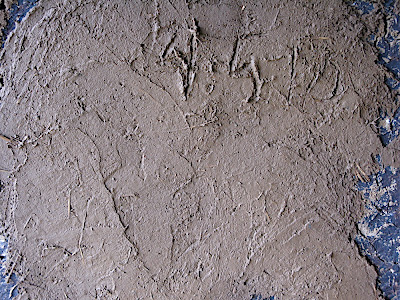
This mix hardly developed any cracks, thanks to the added straw.
Overall I think I used too much water in the mixes, and next time I will try to measure the amount of water going in. I would also like to see what will happen when I use finer sand, or use shredded paper (from the office) to add texture.
When applying the final mix to our walls, we should usually use several layers. The first one can be crude, and cracking may actually help the next layers to bind and stick better. Top and finishing layers should be smooth, so that water cannot erode the wall.
Monday, 26 November 2007
Patching up cracks
As mentioned before the house has many openings which allows both wasps and wind to enter the house. Most of the problem seems to be caused by shrinkage in the wall's mortar mix. According to my study on the subject, either clay or water content was too high. Some of the shrinkage is up to 2cm. 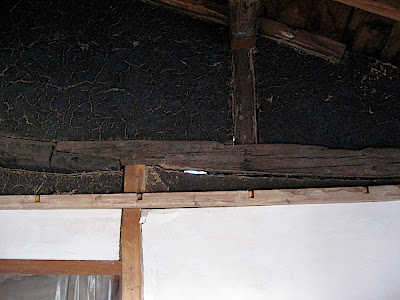
This photo shows the sky seen through the gaps in the wall from the inside.
I bought some sand at a local DIY shop, and mixed it with the soil sample I took from the forest earlier. Than I added some straw from my September weed-battle.
Sand: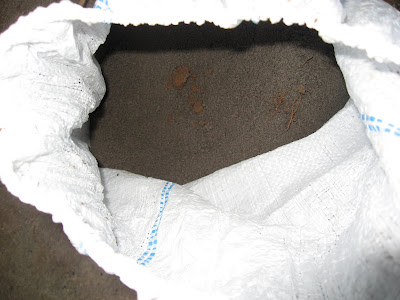
Soil with high clay content: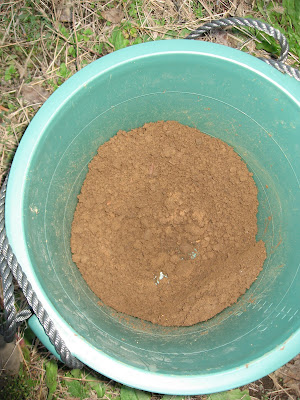
Mixed together: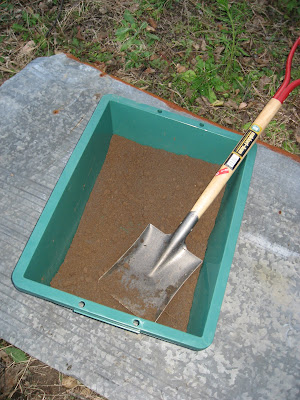
I added the straw from the back to make it stickier.
As the mixture was ready, I deployed it in the North Eastern bed room to seal the cracks. With a small trowel, I pushed and pressed the mix into the gaps, smoothing it at the end.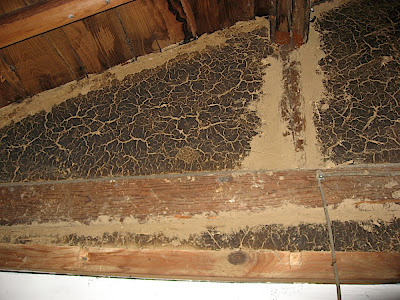
Its not pretty at this stage, but it does the job, and later on a beautiful surface layer will be apllied over this rough layer anyway.
Searching the Forest
This is a late post of the previous weekend. I headed out early Saturday, and arrived around 8 o' clock the ground and fields were covered by morning frost, which provided a nice contrast to the clear blue sky.
Tired from driving, I headed out into the forest to search for possible building materials. The little stream going past our house leads up into to the forest, and on its banks I found a patch of strong bamboo poles growing. I went deeper into forest, and checked out the earth on the steeper river banks. At one place I spotted some slightly red coloured earth. After scratching off the top layer of decaying leaves, insects and other organic matter, I grabbed a handful of slightly moist dirt, an shaped it into a ball. It had excellent cohesive properties, which led me to believe that the soil has a high clay content.
When walking here you have to be careful, and better stay on the path. Farmers have marked off some areas with plastic ribbons, where they cultivate mushrooms (matsutake or something like that). They won't be happy if heavy boots would crush their crop.
Near the path I found some kind of grass that looked long and solid enough to be used , for example inside walls, as insulating infill or to provide a lattice for mud and plaster to stick on. I cut a few stalks as sample and took them with me to dry them out in the sun. Later I found out they were actually kind of baby bamboo sticks.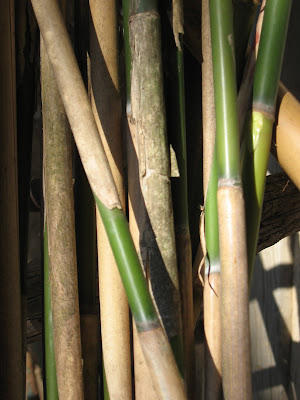
Later I went back and picked up another sample of earth from a different place. It didn't look quite as suitable as the previous one, but I tried out a mix all the same.
