The previous weekend we were dogged by bad luck with the weather. Whenever we wanted to start mixing mud, it started hammering down with rain. Hot and cold air fronts hitting each other created two full days of non-stop electric storms. As a result we didn't get much work done, however it was quite a spectacle to behold.
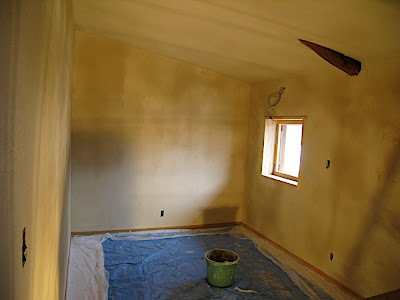
Our intention was to close the highest odd-shaped panels with mud, so we stapled some metal lath on the beams surrounding the openings. The reed was not really usable here because the openings were very small, and we couldn't fit the drill in. Unfortunately, the metal lath didn't work so well: it was floppy so that when applying a little pressure, bits and pieces of mud would fall off. If we used to much pressure, mud would just fall through the lath. I therefore tried to get some mud to stick at least, and next time we try it may offer a better, stickier surface.
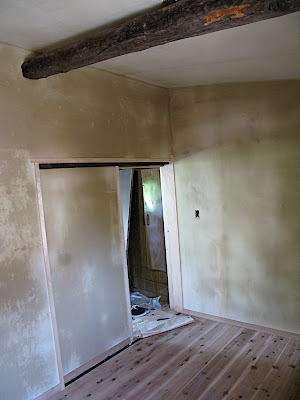
In any case, while we battling the elements, a young, up-and-coming Japanese artist stayed at our house. Ryo Matsuoka absorbed the environment and atmosphere of the building, and surrounding fields+nature to create paintings on the Fusuma (Japanese sliding door), as well as a wood panel and a cupboard. You can find his impressions on his website: http://www.ryoart.com/nagawa08/08july.html
You can see the creation story here:
Of course we did not let the opportunity slip, and PeterO began a fully fledged improvised interview. Jan, his wife, kindly prepared and excellent translation that I used to add English subtitles. Interview is uploaded to youtube, and you can watch it here:
For those who don't have the patience to watch, here is the translation:
Interview with artist, Ryo Matsuoka, on July 27, 2008
Peter: First of all, thank you for coming to Inaka Home. I believe this is your second time painting on fusuma doors (Japanese sliding doors)?
Matsuoka: Yes
Peter: I understand that you have spent one night here already and that you will stay for another two or three days as you continue to paint. I have been watching you work today, and I am very interested to know what you saw and what you felt while staying here in order to come up with this image as your final product.
Matsuoka: Rather than creating a specific image, I clear my thoughts of everything and start from zero. That way, I can bring forth something new and fresh that incorporates all that I saw or felt or touched. I’ve been doing this since I was a child. I make a sketch diary of what I’ve experienced. These are some sketches I did while I stayed here. I picture things I experienced and then I clear everything out of my mind and relegate everything to zero and a bigger picture evolves.
Peter: You mention your sketch diary. For example, take the first one you have in your hand. What is that image? Is that a bird? Rather than objects, are these expressions of your feelings?
Matsuoka: Yes that’s right.
Peter: So then what was the feeling you felt when you created today’s images on the doors?
Matsuoka: What was it, I wonder? This is something that I can only create here and now. It’s hard to pinpoint an exact feeling or thought to this or to label a title to this piece. It started from the moment I got on the bullet train from Tokyo to come out here, eating, meeting people, hearing the thunder, being surprised by the beauty of the stars, seeing the biggest spider ever; all of these experiences from this place come together like a living book, which I throw against the panel and it creates this image.
Peter: You had mentioned that you sketch some images first, then you zero yourself and then you begin painting. As I watched you work today, I noticed that you would paint and then you would pause to look at what you painted and then you would paint again. In the first stage of painting, your pauses were about 10-20 seconds, and gradually the pauses became longer as the painting time became shorter. In the final stage, you would wait for 2-3 hours, then paint one stroke.
Matsuoka: (Laughing) Yes, that’s right. Interesting.
Peter: Can you tell us what is going through your mind during these stages?
Matsuoka: In the beginning, I work on a white canvas and follow my instincts. It’s not complicated nor strange, I just start painting and see where it takes me and see what shapes emerge, and follow along. Then I begin the process of slicing or shaving off layers and that’s probably when the time shift occurs.
Peter: Today’s date is July 27, 2008 and you can only draw this particular image today. So what will tomorrow’s image look like?
Matsuoka: I don’t know. Something very different.
Peter: You will also paint the areas to the right, in the tokonoma and on the other door?
Matsuoka: Yes, and also the door on the other side. I wonder what it will look like. I hope when I look at my finished product, I am surprised by it or am pleased with how it turned out. It’s something that was just instantly created and not preconceived.
Peter: Is this your technique as an artist?
Matsuoka: Yes, as a child I loved to draw and have been drawing ever since.
Peter: So you would call this abstract art?
Matsuoka: When I was little, my father would draw and sketch and use oils. And now I’m painting abstract art, but I also draw travel diaries. I draw words, or rather they are more like symbols. I try to embody words. If I meet someone, I would draw that experience. It is not so much my drawing of the impression I had, but more about the person himself. It’s like a diary. And this painting today is a part of my diary that I could only draw here. And this will continue on with the next place I visit and the next.
Peter: Thank you very much for coming to Inaka Home and for painting this for us.
Matsuoka: Thank you very much.